

Know your data can be trusted, with the evidence to prove it.
VISEON Data Assurance scores every row inside your own environment, against the nine DAMA quality dimensions, and only the results come back. It shows the evidence behind every number and keeps watching, so problems surface when they happen, not when you are audited.
100%
of rows assessed, so failing-record counts are exact, never extrapolated.
9
DAMA quality dimensions, aligned to ISO/IEC 25012.
20+
sources, from cloud warehouses to QVDs on your own file share.
3 days
to MCP-ready governance over your own data estate.
In one minute
See VISEON Data Assurance at work.
Every row scored where it lives, one honest score, and an alert when it breaks. Music only, with the on-screen text below.
Read the on-screen text
- 4,812 bad records: missing, invalid, duplicated and stale.
- Revenue this quarter, £2.4M. The dashboard looks fine. Actually, £1.9M. The number isn’t.
- Who checks the data before anyone trusts it?
- VISEON Data Assurance. Quality, compliance and governance. At source.
- 17 sources, including Snowflake, Databricks, BigQuery, Redshift, SQL Server, MySQL, Excel, SharePoint and cloud storage. Plugged in where your data already lives.
- 4,000,000 rows checked in your warehouse. Every row. Not a sample. Checks run as SQL inside your warehouse. The data never leaves.
- Nine dimensions. One honest score: 97.16, quality gate failed, 127 blocker records.
- Incident opened on orders: quality gate failed, alerts to Slack, Teams and email. It tells you when it breaks. Resolved. And when it’s fixed.
- Card numbers in clear text, masked as 4111 •••• •••• 1111. Found. Never stored. ISO/IEC 29100, GDPR, PCI DSS.
- AI suggests the rules you missed: order_id follows O######, currency is a 3-letter code, total_amount stays under 5,000. It reads the shape of your data. Never the values.
- “What’s failing right now?” “2 blockers. orders has 127 records with no customer, and payments stores card numbers in clear text.” Ask in plain English. Claude, ChatGPT, any MCP client.
- Behind a firewall? It runs there. Outbound only. Nothing comes in.
- Every dataset. One view: 10 datasets, 70% healthy, 2 gate failures, 101 runs in 30 days.
- Down to the record that broke it: orders on Amazon Redshift, 97.16, with each failed record, such as 0000047, customer_id empty.
- Trust the numbers.
- VISEON Data Assurance. viseon.io/viseon-data-assurance
The problem
A green score on a sample is not assurance.
Checking a sample and extrapolating is a common shortcut. On a million-row table, a green score from a few thousand rows can hide thousands of broken records, and you find out when a report is wrong, a regulator asks, or a customer complains.
Quality is also often measured after data has been copied and reshaped, so what gets graded is a pipeline’s output rather than the data you actually own.
All pass. Looks green.
5 fail, each with a reason.
Illustration
What we do about it
Assessment runs where your data lives: as SQL inside your warehouse, or, for files, in a temporary engine at the edge that is deleted when the run completes. No pipelines, no staging area, nothing retained. Only the results come back: exact failing-row counts instead of estimates, the IDs of the rows that failed, and a plain-English reason for each. Dimensions we cannot legitimately evidence from your data are marked not assessed and left out of the score, never quietly counted as full marks.
How it works
From connection to confidence, in five steps
Connect
Point it at a warehouse, database, object store, SharePoint or a file. Credentials are saved as encrypted profiles and never reach the browser.
Score
Every row is checked across the nine dimensions, with rules inferred from your data, refined with AI, then pinned so every run is scored the same way.
Detect and alert
Incidents open when a dataset breaches its expected range, and reach its owner in Slack, Microsoft Teams or email.
Resolve
See exactly which rows failed and why, fix them at source, and watch the incident close itself on the next run.
Prove
Trends, compliance mappings, approvals and a full run history show what your data can demonstrate, and since when.
Scored in place
Assessed where your data already lives
No pipeline to build, no staging area, nothing retained. For a warehouse or lakehouse table, the checks run as SQL inside your own engine. Files and cloud storage are processed at the edge, in a temporary engine that is deleted when the run completes. Either way, only the results come back, with the IDs of any failing rows.
- Full tables, well beyond 100,000 rows. Pushdown means even a very large table costs your engine one query, and nothing leaves it.
- Credential profiles. Secrets stay server-side, and a schedule reuses a saved profile without anyone retyping a password.
- Accuracy and referential integrity. Check values against authoritative lookups and reference tables as part of the same run.
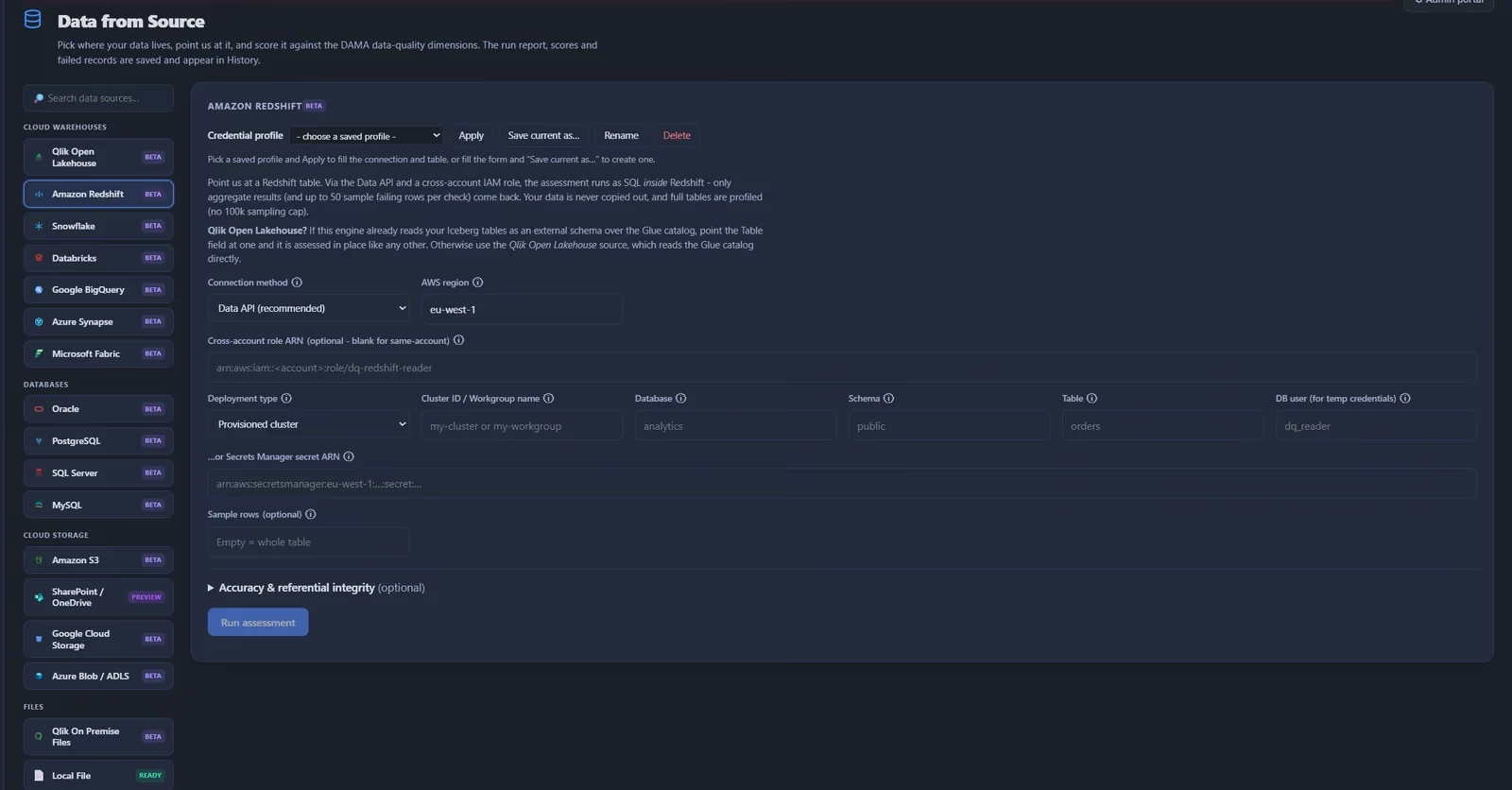
Warehouses and lakehouses
- Snowflake
- Databricks
- Google BigQuery
- Amazon Redshift
- Azure Synapse
- Microsoft Fabric
- Qlik Open Lakehouse
- Apache Iceberg tables
Databases
- Oracle
- SQL Server
- PostgreSQL
- MySQL
Cloud storage
- Amazon S3
- Azure Blob and ADLS
- Google Cloud Storage
- SharePoint and OneDrive
Files and Qlik
- Parquet
- CSV and Excel
- JSON
- Qlik QVD
- Qlik app data
- On-premises file shares
Exact, not extrapolated
Every row, not a sample
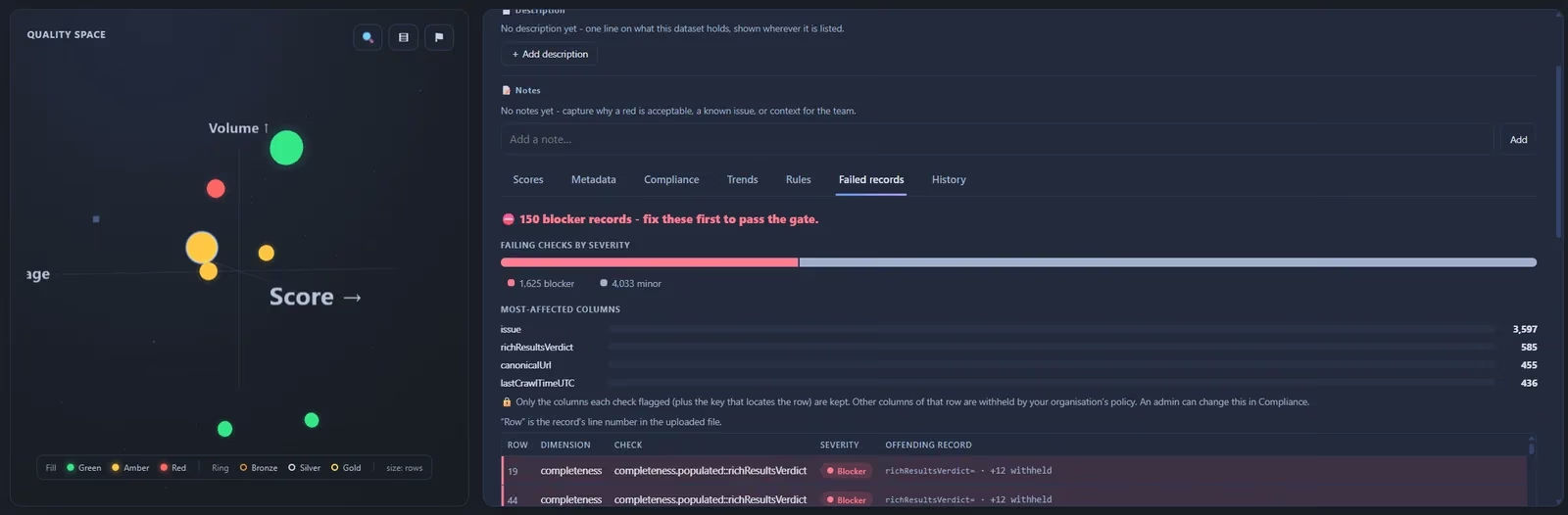
Failing-record counts are exact rather than estimated, so when a number is challenged in a meeting, it holds up. Every dataset opens on its evidence: which checks failed, how many records, in which columns, and the IDs of the rows to fix.
- A quality gate. Blocker checks decide whether a dataset passes, and the page says exactly what to fix first.
- Severity at a glance. Failing checks broken down by severity, with the most affected columns ranked.
- Private by design. Failing rows come back as IDs, never as the values that failed.
- The Quality Space. Every dataset placed by score, volume and stage, so the outliers find you.
The nine DAMA dimensions, scored honestly
Drawn from DAMA DMBOK and aligned to ISO/IEC 25012. Anything your data cannot evidence is marked not assessed rather than counted as a pass.
- Completeness
- Validity
- Uniqueness
- Consistency
- Accuracy
- Timeliness
- Integrity
- Precision
- Reasonability
Monitoring that chases people
Continuous, not a one-off audit
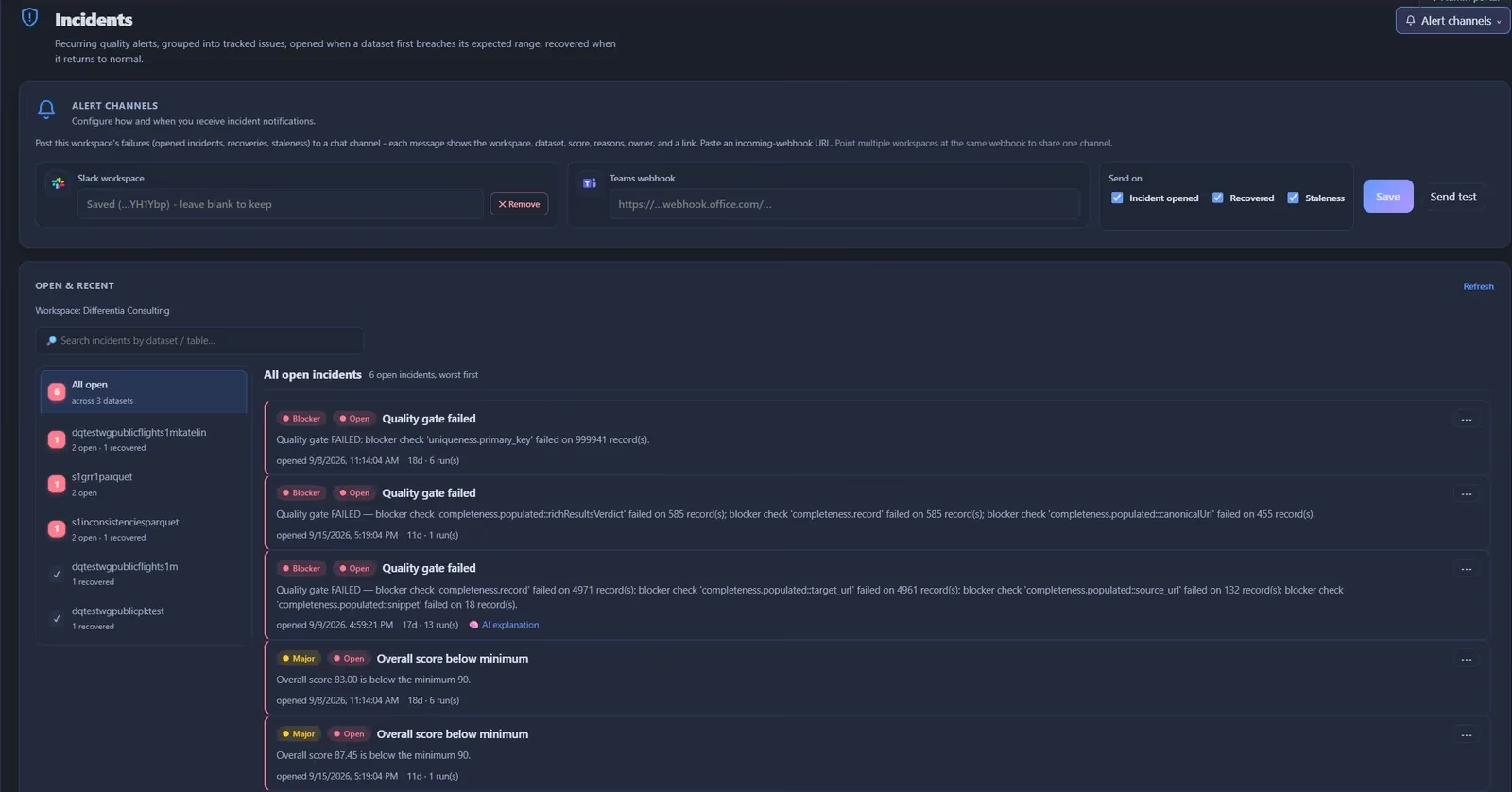
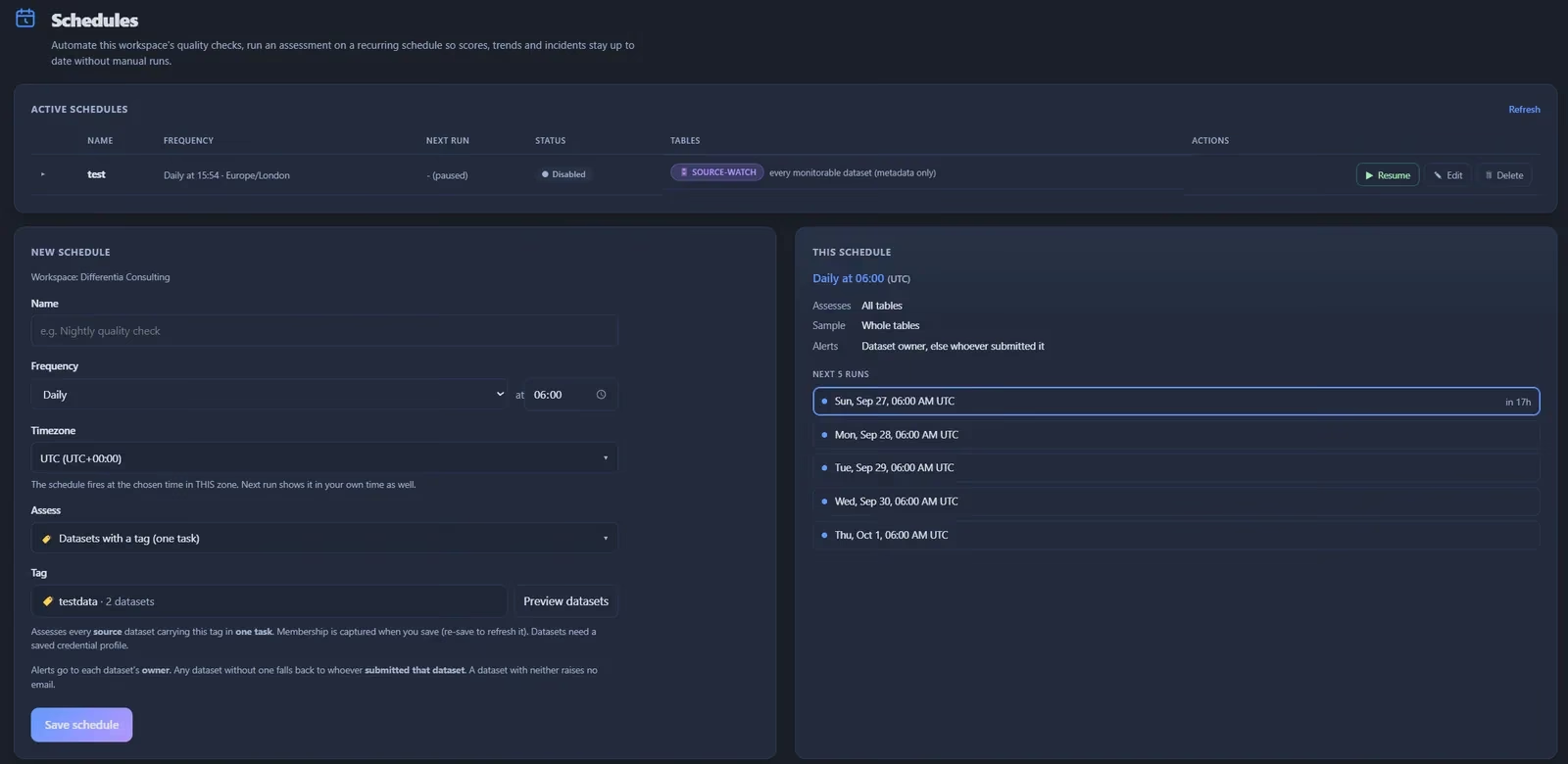
Assessments run on a schedule, and between them each source is watched for volume, schema and freshness changes. When something moves, an incident opens and the right person hears about it: once when it opens, and once when it clears, not on every run.
- Self-closing incidents. Opened when a dataset breaches its expected range, recovered when it returns to normal.
- Alerts where your team works. Slack, Microsoft Teams and email, routed to the dataset’s owner.
- Schedules by dataset or by tag. See the next five runs before you save, in your own timezone.
- A second opinion on demand. An AI explanation of any incident, grounded in the run’s own evidence.
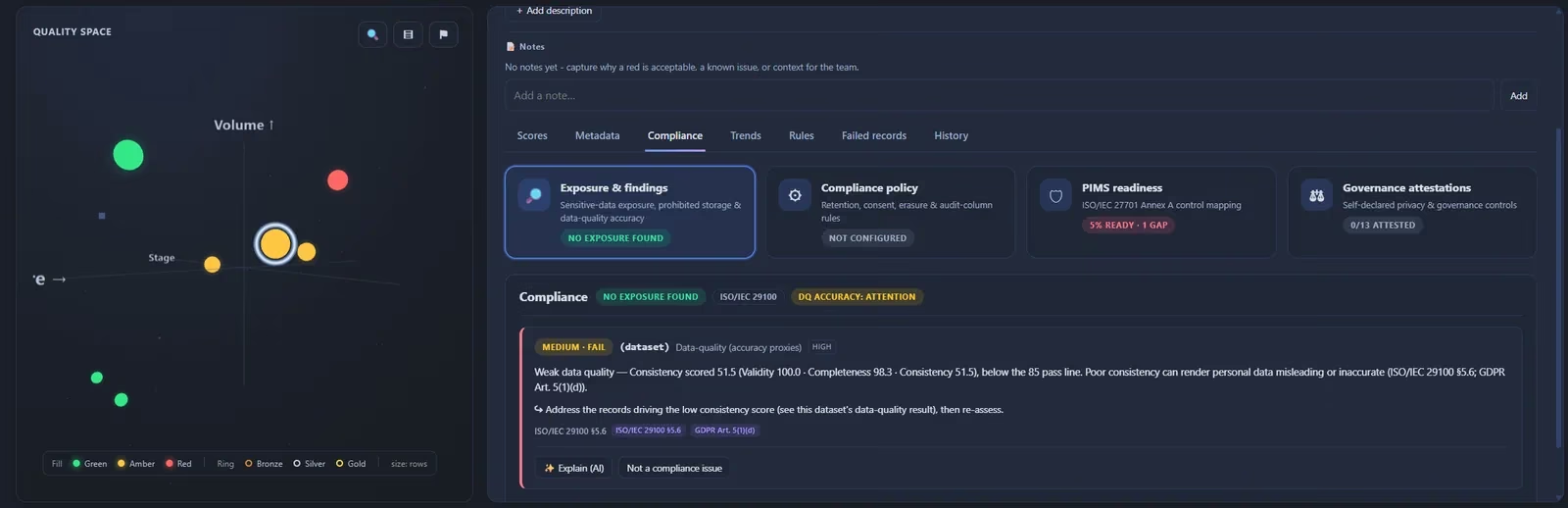
Compliance built in
Built for governed environments
Personal data is detected and reported as present, never stored as a value, and failing records are identified by ID rather than kept. Findings cite the clause they relate to, so a quality problem that is also a privacy problem is flagged as one.
- Mapped to the standards you answer to. DAMA DMBOK, ISO/IEC 25012, ISO/IEC 29100, ISO/IEC 27701 and GDPR.
- Regulation packs, or your own. HIPAA, CCPA and BCBS 239 packs, and room for your internal framework.
- One view of your posture. ISO/IEC 27701 readiness, retention, consent and erasure rules, and governance attestations.
- DAMA DMBOK
- ISO/IEC 25012
- ISO/IEC 29100
- ISO/IEC 27701
- GDPR
- HIPAA
- CCPA
- BCBS 239
- + Your framework
Lineage
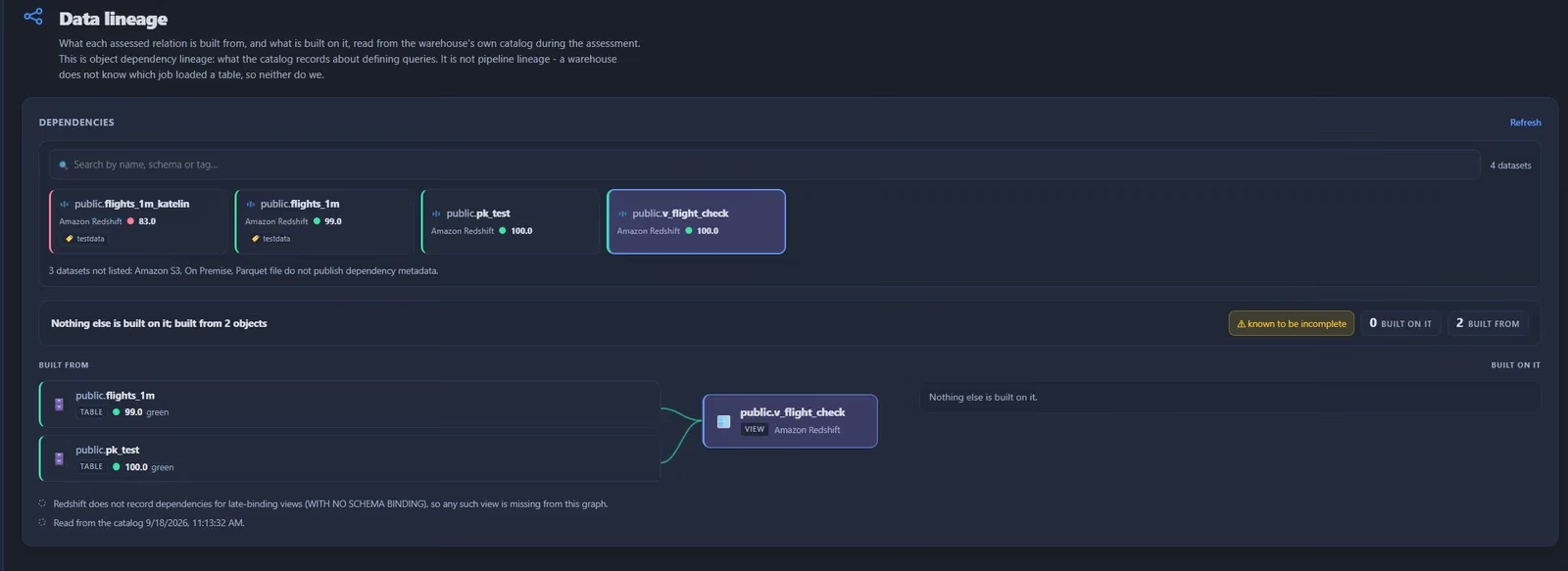
See what every table is built from
Dependencies are read from the warehouse’s own catalog during the assessment: what each table or view is built from, and what is built on it, with every dependency carrying its own quality score.
- A bad input explains a bad output. Follow a red view back to the table that dragged it down.
- Honest about the gaps. Where a catalog is known to be incomplete, the page says so rather than drawing a guess.
AI assistant, via MCP
Ask the AI Assistant in plain English
Connect Claude, ChatGPT or any MCP client to the platform and ask what you actually want to know: which datasets are failing, what changed this week, why a score dropped. Answers come from the platform’s own figures rather than a re-derivation, so the assistant and the screen never disagree.
- What’s the current state of my datasets?
- Open the red dataset
- What changed this week?
- Why did this score drop?
- Which incidents are still open?
- It sees what you can see. Connected from Qlik, one app. Connected to the portal, only what your role allows.
- It never sees your data values. It works from scores, counts, reasons and row IDs.
- It acts within limits. It can re-run an assessment and, for admins, record approval decisions. It cannot create a dataset or edit a rule, policy or attestation.
Ready-made skills for health briefings, incident triage, dataset deep dives, trend investigations and compliance reviews.
Recorded in Claude, connected to Data Assurance over MCP.
On-premises agent
Inside your network, too
Some data never leaves the building. The VISEON agent is a small Windows service that runs inside your network, reaches out over HTTPS for work, and assesses databases and files where they sit. Nothing connects in.
- Outbound onlyNo inbound ports, no VPN, no address for anyone to reach.
- Passwords stay putHeld on your machine. VISEON keeps a pointer, never the value.
- Only the folders you allowEvery job is checked before it runs, and anything else is refused.
- Large files, in placeParquet and CSV assessed where they sit, without loading them into memory.
What’s in the box
Evidence-based. Transparent. Actionable.
Full-table scoring
Every row assessed through SQL pushdown. Exact counts, at any scale.
Scored where it lives
Warehouses, databases, object stores, SharePoint and files, through one engine.
Nine DAMA dimensions
Completeness to reasonability, scored honestly and aligned to DAMA DMBOK and ISO/IEC 25012.
Compliance built in
An ISO/IEC 29100 privacy lens with GDPR, HIPAA, CCPA and BCBS 239 packs, or your own standard.
Privacy by design
Personal data is detected and reported as present. The values themselves are never stored.
Monitoring that chases people
Incidents open, route to an owner, alert Slack or Teams, and resolve themselves when fixed.
Governance you can act on
Medallion stages, ownership, endorsements and an approvals workflow for what teams publish.
AI where it helps
Rules inferred from your data and reviewed with AI, then pinned, so every run is scored the same way.
Three ways to use it
One engine, wherever your teams work
A web portal
For data owners, stewards and governance teams. Workspaces, roles and tag-based access decide who sees what.
Inside Qlik Cloud
An extension that assesses your app’s own tables beside the analytics built on them, with the app’s data model and lineage.
Any MCP client
Claude, ChatGPT or any assistant that speaks the Model Context Protocol, answering from the same figures.
The same engine and the same numbers, whichever your teams prefer.

Evidence toward compliance, not a certification.
Scores describe what your data can demonstrate. Where something is not assessable, we say so rather than guess, because a number you cannot defend is worse than no number at all.
Questions
What teams ask first
Does our data leave our environment?
No. Warehouse and lakehouse checks run as SQL inside your own engine. Files and cloud storage are processed at the edge, in a temporary engine that is deleted when the run completes. Only the results come back: scores, counts, reasons and the IDs of failing rows, never the failing values.
How is personal data handled?
It is detected and reported as present, and never stored as a value. Failing records are returned as row IDs only, so you can find and fix them at source without the values ever leaving your environment.
Is this a compliance certification?
No. It is evidence toward compliance. Findings cite the clause they relate to, for example ISO/IEC 29100 or GDPR Article 5, and anything that cannot be assessed from the data is marked not assessed rather than guessed.
Which sources can it assess?
Snowflake, Databricks, Google BigQuery, Amazon Redshift, Azure Synapse, Microsoft Fabric, Qlik Open Lakehouse, Apache Iceberg tables, Oracle, SQL Server, PostgreSQL, MySQL, Amazon S3, Azure Blob and ADLS, Google Cloud Storage, SharePoint and OneDrive, plus Parquet, CSV, Excel, JSON and Qlik QVD files, on-premises file shares, and the data inside a Qlik app.
What can the AI assistant do, and not do?
It can answer from everything you are allowed to see, re-run an assessment, and, for admins, record approval decisions. It cannot create a dataset or edit a rule, compliance policy or attestation, and it never receives your data values.
Our data is on-premises. Can you reach it?
Yes, without anything connecting in. The VISEON agent runs as a Windows service inside your network, polls out over HTTPS for work, keeps database passwords on your machine, reads only the folders you allow, and sends back only the results.
See it run against your own data
Establish where your data stands on AI readiness, with MCP-ready governance over your private data estate in as little as 3 days.
Or email [email protected]